
A room can look attractive and still make everyday life awkward. A chair may block the kitchen route or work papers may occupy the only eating surface. Comfort begins with how the room works.
Try a practical walkthrough of one small space. Imagine a combined living and dining room with a sofa, a table used for meals and work, and a narrow entrance. The following steps show how to improve it without assuming you can buy furniture or alter the building.
Follow the route from the doorway
Enter as you normally would, carrying your usual bag or using your mobility aid. Notice where you turn sideways, move an object, or temporarily put something on the floor. Then follow the route to the seat, table, and next room.
In the example room, a chair pulled away from the table narrows the entrance. Before adding storage, move the chair to a position that leaves a usable route when someone is seated. Test the arrangement with the actual people and equipment that use it.
The National Institute on Aging recommends arranging furniture and objects so they do not obstruct walking routes. Do not create a new obstacle while solving an old one, and keep exits clear. Get help with heavy furniture instead of attempting an unsafe lift.
Give arriving belongings a workable destination
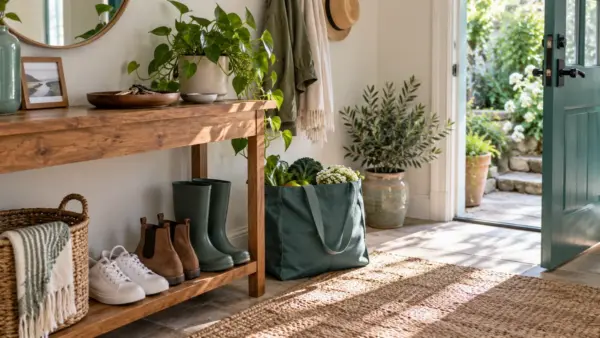
A bag dropped beside the door may indicate that its official storage place is inconvenient. Choose a reachable hook, shelf, or existing basket near the point where you naturally put it down. Check that the item does not project into the route.
In the example room, an existing shelf holds keys and outgoing paperwork, while the bag has a separate place. Keep the shelf limited to items involved in arriving and leaving.
For systems that connect belongings with appointments and tasks, see everyday organization. Here, focus on whether the physical location makes the next action easier.
Help one table serve several purposes
List what happens at the table: eating, working, homework, sewing, or sorting mail. Identify what must remain there and what can travel together. A shallow container can hold one activity’s materials so they move as a group.
For example, put the laptop accessories and notebook in an existing box when work ends. Keep a separate tray for a small craft project. Store both within comfortable reach of the table, leaving enough space to pull out a chair without moving them again.
Test the transition by actually setting a place for a meal. If clearing the table requires ten separate trips, simplify the setup. A multipurpose room works better when changing activities has a short, obvious sequence.
Arrange supplies around the seated position
Sit where you usually read, work, or make things. Notice what you can reach without leaning awkwardly or getting up repeatedly. Put frequently used items in that area, while keeping enough space for comfortable movement.
In the example room, the sewing supplies move from a low cupboard to a reachable shelf. Less frequently used items take the harder-to-reach space. A lightweight container with a manageable handle is more useful than a beautiful box that is difficult to lift.
Avoid treating a generic layout as an accessibility assessment. If reaching, transfers, balance, or wheelchair access are difficult, an occupational therapist or another qualified professional can suggest changes suited to you. Your familiar furniture may still need a different arrangement.
Make room for an activity you want to do
Choose one enjoyable activity that currently lacks a usable place. You might need room for a puzzle, a musical instrument, a plant, or a small drawing pad. Determine the actual footprint before moving everything else.
Test a temporary arrangement first. A portable board can hold an unfinished puzzle if you have somewhere safe to store it. A project container can make drawing possible at the shared table.
Our guide to making time for hobbies explores the time side of this problem. A usable setup addresses the space side: the materials are available, and beginning does not require rearranging the whole room.
Display personal objects where you encounter them
Choose a few objects whose presence you enjoy: a family photograph, an inherited bowl, a postcard, or something you made. Consider where you naturally look while sitting or entering, rather than placing everything on a high shelf.
Group objects in a stable location that does not obstruct essential surfaces or routes. You can rotate them if space is limited. There is no need to discard meaningful possessions to achieve a uniform decorative style.
Ask before moving someone else’s objects. A shared room should reflect their uses and attachments too.
Live with the arrangement before buying anything
Try the changes for a week, including a busy day. Does the entrance remain usable? Can the table switch activities easily? Can each person reach what they need? Revise the placement that keeps causing trouble.
Once the layout works, consider its sensory qualities with making your home feel calm and refreshing. The room needs to support your life, not look finished.
Frequently Asked Questions
Follow one daily route, such as entering and sitting down. Fix the first repeated obstacle, then test the change before tackling another area. One useful adjustment is enough to begin.
Keep each activity’s movable materials together in a manageable container, with nearby storage. Practice clearing and resetting the table so the transition does not require repeated trips or heavy lifting.
Not automatically. Choose stable, usable display locations and keep essential routes clear. Personal objects can remain part of the room without occupying every working surface or following a single decorative style.